PLANNING – HOW FAR SHOULD YOU GO?
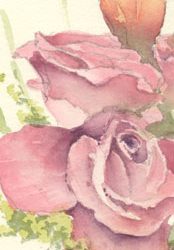
By it’s very nature, watercolour is unpredictable. Many are daunted by this and often, quite reasonably, decide to opt for a medium that offers greater control, whilst others positively revel in the apparent mayhem attributable to watercolour. Occasionally, newcomers to the discipline discover hitherto undiscovered depths to their personality (anger, impatience, rage amongst others). A resilience is needed when tackling what often seem like the simplest of tasks; the ability to pick yourself up, brush yourself down and try it all over again being a useful personal attribute.
But if watercolour is so unpredictable, how does one go about planning a painting? If one’s aspirations are constantly going to be dashed at the first fence every time, simply because of the instability of the medium, what hope does anyone have of achieving success?
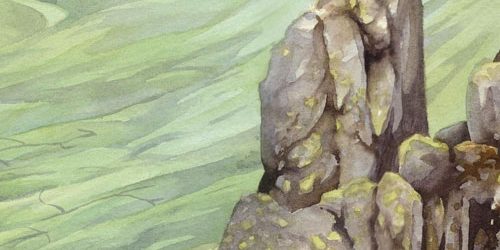
My answer is simply this: Yes, have a plan, but don’t be too determined to stick absolutely rigidly to it. Be prepared for the unexpected and don’t view every accident as a failure. A term often used in watercoloury circles is ‘happy accident’. Not only is this mythical event a reality, the results of happy accidents are often the best bits of a painting, and you can always pretend you meant to do it in the first place!
So how much should you plan of your painting, and what is the best order in which to approach it? Since this piece was prompted by question raised in the Artists’ Forum, I’m going to paraphrase my reply in order to offer an answer to the question.
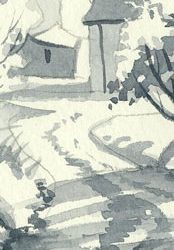
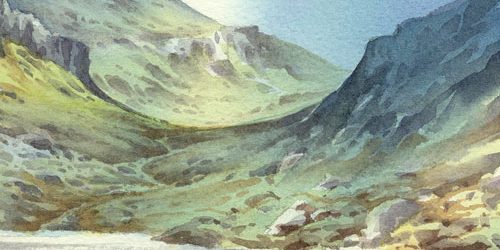
There is no rule book that says you must do this, followed by that, and then this should follow on and so on. The only rule we’re rather stuck with (assuming we’re not mixing media) is that we have to work light to dark, so I suggest, if all else fails, that you consider using that as your starting point. Work out where your lightest bits are going to be (and it’s not always the sky) and go from there: a natural progression of light tones, to mid-tones to dark tones. Starting a painting with an all-over wet-in-wet wash might also be worth considering. A wet-in-wet wash to start with can give you a good, solid ‘underpainting’, where quiet, unexplained patches speak for themselves and don’t need to be interpreted.
Approaching your painting in a slightly looser way might result in a stronger overall composition, one that just ‘holds together’ better. Over time, we all develop a working practice of sorts (for some this may take longer than others, but it will happen). A game plan gives us security, and makes the painting process a more comfortable experience, but can lead the unwary into a rut. It’s generally not a good idea to be too rigid in your approach. Painting is an organic process, and every painting should be treated as an individual entity.
Those early washes can be crucial to the success or failure of a painting – make ’em big, and make ’em loose, and look for the unexpected. Make the ‘happy accident’ work for you!