Line and Wash – A Fusion of Styles
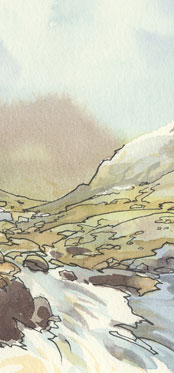
I have a bit of a soft spot for Line & Wash. Second only to the pencil, it’s a favourite sketching medium of mine when I’m working out of doors in difficult circumstances and time is short.
I do get slightly frustrated, however, when I see folks using it in a ‘lazy’ way. I’ve lost count of the number of times I’ve seen people reach a point in their watercolour painting when they start to lose interest in it; get bored, or can’t decide how to finish it off, so they reach for the ink pen, and simply draw around it….
The reason I consider it lazy is because they didn’t set out with the intention of doing that, and the outlining of objects, in what might otherwise have been a perfectly acceptable watercolour if only they could have been bothered to finish it off correctly, is a just a quick and easy way of defining objects that should otherwise be defined by contrast and not a line of ink.
As an example; if you’ve drawn and painted in a chimney stack on a house, and the chimney is the same tone as the sky behind it, then almost certainly it is only the line (whether in pencil or ink) that defines the object. If you were to remove the line, the object would disappear. The correct, pure watercolour, solution to this clashing of tones of equal value is not to draw around it, but to modify the tones – either make the chimney stack darker, or darken the sky behind it (or add a dark tree, perhaps) to make the chimney stack stand out light against a dark background. This engineering of tones to enhance or exaggerate objects is something we should be doing constantly in watercolour, anyway.
Line and wash, for me, should be a fusion of watercolour and ink drawing, where neither one nor the other of the two styles are dominant. I like to start with a loose, impressionistic watercolour wash, then take hints from it when drawing out the scene in ink. Before completing the ink drawing, I would then swap back to the watercolour, and develop it by taking hints from my ink drawing. By swapping back and forth between the two disciplines, several times over, I find a composition will develop in a more natural way, where neither style is dominant, but rather each supports, and takes hints from, the other.


