Simplifying Windows
Anyone who knows me well knows that I hate windows…
… having suffered at the hands of Windows 10 automatic updates, rendering my laptop totally inoperable several times in as many months and requiring a string of total system restores, I feel I should include Microsoft’s new operating system along with this. Call me old fashioned, but I don’t have any wish to see my operating system ‘evolve’ over time – particularly when I have no control over it… I don’t particularly want to talk to it, or for it to talk back to me; I just want it to do what it is supposed to do, with the minimum of fuss…
…sorry… just got a little distracted there…
I don’t mean I’m pathelogically traumatised by the presence of windows in a building, but they do present several challenges.
By their very nature, windows are geometric objects that change in appearance according to where they are being viewed from. The top and bottom lines of each will slope, and meet at an appropriate vanishing point, according to the viewer’s eye level. In a large building sporting lots of windows, this needs to be multiplied many times over.
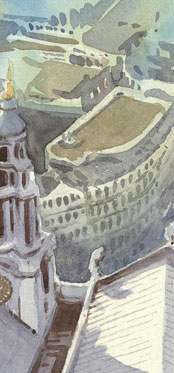
In a watercolour, where a certain implied looseness can often look better than architectural precision, I find the best way to approach such things is not to even try and paint every angle and every corner of every window precisely, but to render them as nothing more than a single brushmark. Providing they diminish in size as they recede away from us, and are positioned relatively accurately in proportion to all adjacent windows, and other elements, then they tend to look okay.
I often see students fall into the trap of trying to get every single angle right, yet forgetting to take into account the fact that, when we look across the surface of a wall with windows, those objects should appear foreshortened. The more acute the angle, the tighter the windows become, until you reach a point where they appear only as a simple, single line anyway… best illustrated as nothing more than a humble single brushmark.
Architects and those from an engineering drawing background will no doubt be spluttering into their coffee as they read such blatant frivolity, but I stand by my approach. After all; isn’t the essence of watercolour all about creating an impression? I know that’s what I always strive for, and am always most impressed by when I see the same in other people’s work. Provide your viewer with just enough visual information by which they can interpret the scene, and leave the rest to their imagination…