Erasing and Lifting-out

Lifting-out watercolour, and erasing pencil, is something that is used, more often than not, for correcting errors.
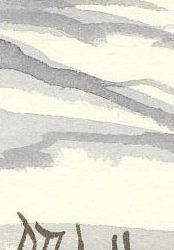
In the video demonstration that I’ve posted this month, I’ve tried to show how the lifting-out technique (technically referred to as ‘Stopping Out’) can be used in a pro-active way. In the case of the demonstration, this means shaping and sculpting cloud shapes through highlighting, but the technique can be used elsewhere too, in all sorts of different ways.
The technique is also applicable to pencil drawing. Try laying down a shading pattern that covers the whole of your paper, and then lifting out highlights with an eraser. Both soft and hard erasers can be used; a soft eraser is best for lifting out subtle areas of highlight, and creating a graduation by altering the pressure you apply. A hard eraser is better for extreme highlights and areas that need a sharp, clean edges.
In watercolour, a scrunched-up piece of tissue is best. You can mould it into a sharp point for fine highlights, and keep it only loosely scrunched for gentle highlights, or scumbling. Timing is crucial; if you lift out the paint when it is still too wet, then the paint will have a tendency to creep back into the shape you’ve lifted out, requiring you to keep repeating it until it settles down. Leave it too late, though, and you’ll struggle to lift the pigment out at all. You’ll need to replace the tissue often, to prevent it from depositing acculumated paint back onto the paper.
From a purist’s point of view, reclaiming highlights in this way is far preferable to resorting to white paint, and more spontaneous than using masking medium.
There are just a couple of important footnotes I feel I should mention here; one is mentioned in the video, the other is not.
The first thing I want to say is that if you’re going to be scrubbing or lifting out paint, you need to be working with a decent, heavyweight, hard-sized paper. Repeatedly painting, then lifting-out, can be surprisingly punishing for a paper; anything too lightweight, or soft-sized will struggle to hold itself together.
Secondly; it’s worth remembering that nothing can replace the whiteness and brightness of untouched, virgin paper. When we lift paint out – even if it is lifted out with some rigour, there will always be a little something left behind. It many not necessarily be visible on the first pass, but after repeatedly applying layers and lifting out, the residue will start to be noticeable. This can be used to our advantage; repeatedly applying paint, then lifting it off, layer after layer, starts to create its very own textural finish. I remember reading of an artist many years ago who built up her paintings deliberately in this way, in order to generate random textures; I’m talking about thirty-plus layers…
Food for thought…