Light Foliage
Sometimes, it’s the little, subtle things that can make all the difference to a painting.
It’s common to think of trees in terms of either those in midsummer, bursting with full foliage, or as skeletal, winter bare trees, without a single leaf to be seen. But there is another state… a sort of a halfway house…
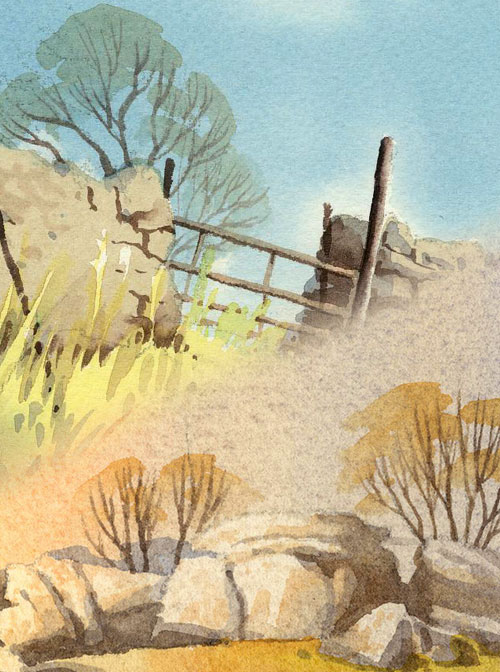
I’m talking, mainly of light, fresh new Spring foliage, but the technique is just as applicable to that period of time at the back end of Autumn, when, for some trees, only a light sprinkling of foliage remains. It can be a challenge to capture if you think only in terms of painting individual leaves, but not so much if you take a more simplified approach.
One way to approach the challenge is to apply your foliage using a dry-brush technique. The only potential problem with that is, because you are applying paint to dry paper, it will result in hard edges throughout. It’s also easy to overwork if all you’re after is a gentle, subtle result.
My favourite method of painting spring foliage (and light autumn foliage – as seen in my recent ‘Brimham Rocks’ video), is to apply it as a light wash, covering the general shape of where you want the leaves to be, but then softening it off with a damp brush, to reduce its prominence a little. If the result is looking too bright or dominant, then a gentle dab with a piece of tissue is generally enough to knock it back, and make it look more integral to the scene.