Snow Tips
Here in the North-East, over the last few days, we’ve been battling with the mighty wrath of Arwen (I’m guessing she had a tiff with Aragorn). Mostly it’s been high winds, seeing off the last of the autumnal foliage, bringing down trees, and dumping rainfall in epic proportions. But there has also been a spectacular amount of snow, with deep drifts closing roads and giving the North Yorkshire Mountain Rescue lots of work to do.
It’s that time of the year when folks turn their attention to hand-painting a few seasonal cards for family and friends. So, if you’re holed up in your house looking at a blank sheet of paper, waiting for some snow-based inspiration to strike, then here are a few hints to help you along your way…
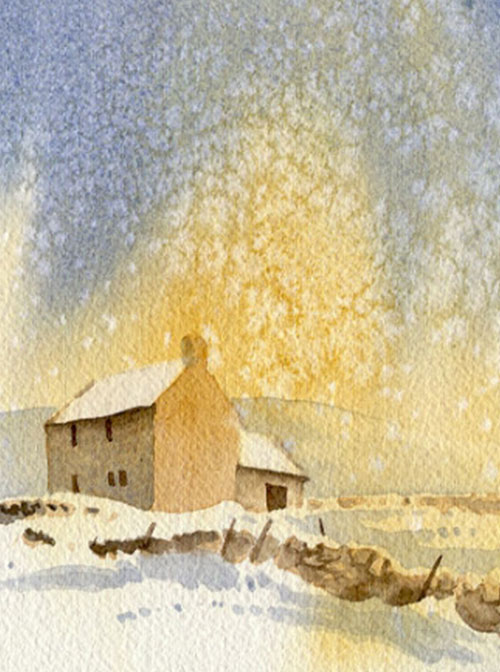
[1] Consider throwing some salt at it… Salt glazing is a great technique for creating a snow blizzard. Simply sprinkle a few sea-salt flakes onto the surface of your initial wet-in-wet wash while it is still damp, and watch as it soaks up the moisture to create a random, blizzard-like pattern. Timing is everything, though; add the salt too early and your pattern will be overly large, add it too late and the salt will have no moisture to soak up at all.
[2] Juxtapose warm with cool. A warm sunset sky not only makes a snowscene more inviting, but the warm hues contrasting against the cooler ones can help to increase the impact of the cooler shadows. Of course, it depends upon the mood and message you’re hoping to convey; if you’re aiming to capture the angry, cold wildness of Storm Arwen, then you might prefer to stick with the blues and the greys.
[3] Speaking of shadows – remember shadows tell us as much about the surface they are falling onto as the objects that are casting them. In other words; be sure to curve your shadows in such a way as to follow, and visually explain, the contours of the snow beneath them.
[4] Use snow to create a strong focal point. By its very nature, snow reduces the world to more simplistic forms, so it’s a good idea to try and expoit that. Use the simplied, decluttered scene to your advantage; pick one element to be your main area of interest and use all the other elements to support it, draw the eye in towards it and not distract the viewer from the focal point.
[5] Avoid repetitive patterns and geometric shapes. It goes without saying that nature can start to look very unnatural if you introduce geometric patterns and too much repetition. This is why using something like salt can be a boon, because it automatically induces the random element.
[6] Add some life with a figure or two (or three)… or, if you’re going to be seasonal, how about throwing a robin in for good measure? Speaking personally, I tend not to put figures into my scenes, but I do acknowledge just what a difference it can make to the way someone might interpret the finished painting. A figure gives your viewer someone to identify with, and can help to give the impression of being actively within the scene. If it’s a Christmas card you’re painting for, then seasonal symbols, such as robins and snowmen, or happy family groups in bright winter apparel (by that, I mean stripey scarves and bobble hats – not high-viz jackets), can help to reinforce those feelings of peace and goodwill to all of our fellow humans… and let’s be honest; that’s a little something that really can’t hurt right now…